

South Asia Enterprise Impact Centre (SAEIC)
Research, Solutions, and Learning for South Asian Enterprise
Institution: South Asian University
Location: New Delhi, India
Mandate: Research · Projects · Executive Education
Established: 04 November 2025
A dedicated centre for applied management research in the SAARC region.
The South Asia Enterprise Impact Centre (SAEIC) was established by South Asian University on 04 November 2025, following the approval of the competent authority. The Centre sits within the Faculty of Management and functions as its dedicated vehicle for applied research, problem-solving projects, and executive education.
SAU is a university established by the South Asian Association for Regional Cooperation (SAARC), serving Afghanistan, Bangladesh, Bhutan, India, Maldives, Nepal, Pakistan, and Sri Lanka. SAEIC extends that regional mandate into the domain of management scholarship and practice.
“A management school serves its region best when its research, its problem-solving work, and its executive learning draw from the same well and feed one another.”
Studying the real problems of the region’s enterprises — and helping resolve them
SAEIC is built on a single operating principle. Research, practice, and teaching are treated as one continuous activity rather than three separate ones. Engagement with enterprises and institutions across South Asia raises the questions the Centre takes up; findings move into teaching cases and executive programmes, and the partners served through those programmes surface the next set of questions.
The Centre’s objectives, as approved by the University, are to promote research, problem-solving projects, and executive education (MDP and FDP). These three strands define SAEIC’s work and anchor every engagement, programme, and publication the Centre produces for the region.
Three pillars. One integrated practice.
i. Applied Research
Faculty and doctoral scholars study questions grounded in the working realities of South Asian organisations. Findings are translated into peer-reviewed papers, teaching cases, and concise practice notes that partners can use.
Focus areas include:
- Digital work and distributed teams
- Service delivery and operations
- Compliance, governance, and ethics
- Environmental and social responsibility
- People systems and organisational behaviour
ii. Problem-Solving Projects
Diagnostic and improvement engagements for corporates, PSUs, and government bodies. Every assignment follows a disciplined structure, with written agreement on the problem, the baseline, and the expected outcome before work begins.
Every engagement carries:
- A written problem statement agreed with the partner
- A baseline record of existing conditions
- A before-and-after result at the close of engagement
- Evidence-backed recommendations signed off by the partner
iii. Executive Education (MDP / FDP)
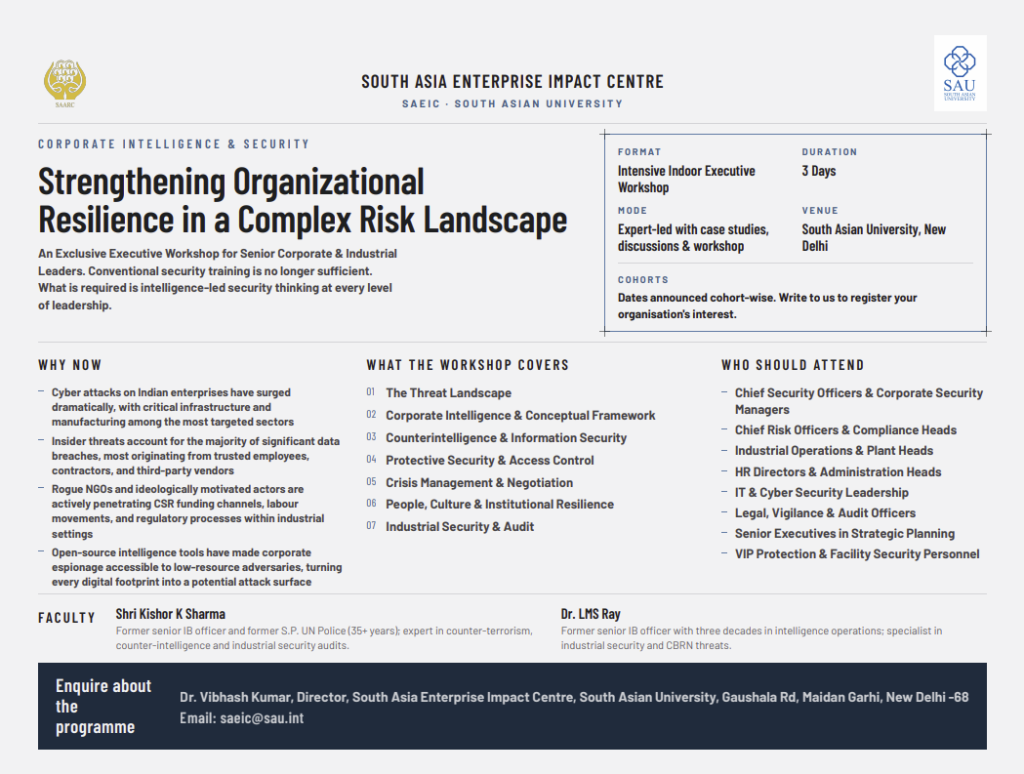
Modular Management Development Programmes and Faculty Development Programmes built on the Centre’s research and project work. Content reflects current regional practice rather than generic material.
Programme formats:
- Short-format programmes, typically two to five days
- Case material drawn from SAEIC’s own engagements
- Delivered at SAU or on the partner’s site
- Open-enrolment and customised formats available
Disciplined, documented, and accountable to the partner.
Every SAEIC engagement follows a three-stage structure. The stages apply equally to consulting projects and, in adapted form, to executive programmes. Nothing is hypothetical; everything is rooted in work SAEIC has done or is doing.
Stage 1 — Problem Statement
Every engagement begins with a written problem statement agreed between SAEIC and the partner. The scope, deliverables, and access to data are defined up front.
Stage 2 — Baseline
Before intervention, the Centre records the current position in numbers wherever possible, what is happening today, measured against agreed indicators.
Stage 3 — Before-and-After
Every project closes with a one-page result setting out the before-and-after position with evidence, signed off by the partner.
“Training programmes use toolkits and cases drawn from this work. Each delivery carries its own roster, feedback record, and a short results note.”
Three ways organisations engage SAEIC
i. Project Partners
Organisations that commission a diagnostic or improvement assignment with SAEIC. Engagements are scoped individually, follow the Centre’s three-stage methodology, and close with a documented before-and-after result.
ii. Training Partners
Organisations that nominate managers and officers for MDP and FDP programmes either through open-enrolment or customised. Programmes draw on SAEIC’s live engagements and faculty research.
iii. Institutional Partners (MoU)
Organisations that enter a longer-term agreement covering projects, training, student internships, and capstone alignment. MoUs may include pathways for sponsored employees to join MBA-Executive programme and Executive Ph.D.
Team
|
DIRECTOR, SAEIC Dr. Vibhash Kumar, Associate Professor (SG), Faculty of Management, South Asian University Members Dr. Ashish Gupta, Associate Professor (SG), Faculty of Management, South Asian University Dr. Parul Kumar, Assistant Professor (SG), Faculty of Management, South Asian University Dr. Ramesh Roshan Das Guru, Assistant Professor (SG), Faculty of Management, South Asian University |
Begin a conversation.
SAEIC welcomes enquiries from corporates, public sector undertakings, government bodies, regional institutions, and academic collaborators across the SAARC region and beyond.
|
ADDRESS AND REACH Centre: South Asia Enterprise Impact Centre (SAEIC) Host: Faculty of Management, South Asian University Address: Rajpur Road, Maidan Garhi, New Delhi 110 068, India Telephone: +91 11 2086 2652 · +91 11 2086 2806 Website: www.sau.int Email: saeic@sau.int |