

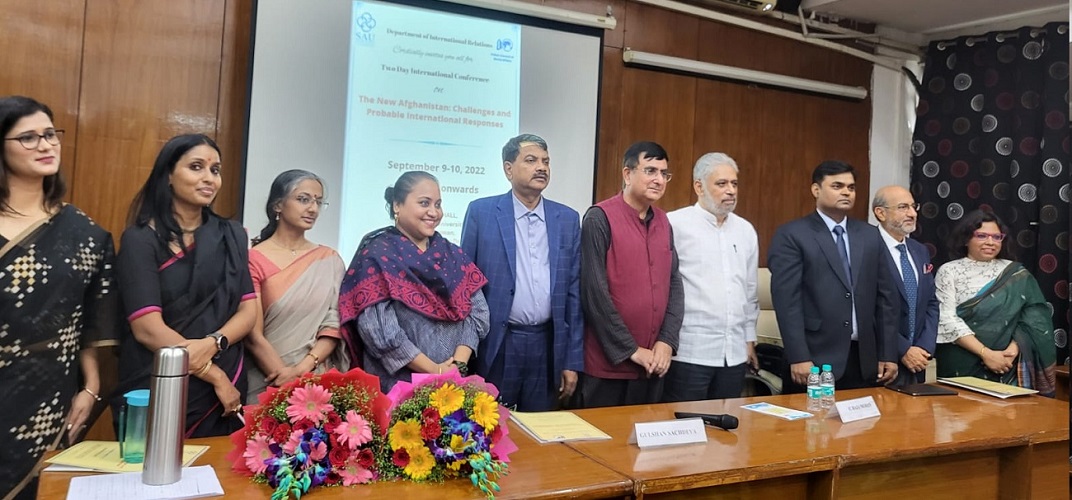
The two-year Masters Programme at the Department of International Relations is designed to encourage students to develop their critical faculties, both within and outside the field of international relations. The composition of its student community, drawn from across the South Asian region gives the programme a unique edge. Through an array of courses ranging from mainstream disciplinary orientations in IR and political science to the contemporary debates in social sciences, students are encouraged to engage with the wider world of politics that inform our intellectual and creative pursuits. The faculty provides an academic direction towards this aim through its teaching and supervision within the programme. The Masters programme at DIR is unique for its emphasis on developing the research orientation of students. The dissertation forms an integral component of the programme and provides them with an early opportunity and intellectual challenge to undertake an intensive exploration of a subject of their choice. This experience will be part of an ongoing conversation between disciplines, between theory and policy and between students and faculty. We welcome you to join us and be part of this exciting exchange of ideas.
Course Objectives: The course aims to introduce students to the dynamic field of security studies. It combines a comprehensive overview of the major theoretical debates in the field with an in-depth
understanding of the key issue areas that impinge upon the notion of security. The course provides a critical evaluation of the contemporary security studies discourse and examines how the field has responded to transformations in world politics. It will further familiarize students with debates on certain core concerns that have compelled policymakers and researchers to widen the conceptual parameters on the security spectrum in diverse physical and virtual spaces such as maritime, polar, cyber, and outer space. (Read More)
Course Objectives:The primary objective of this course is to explore and understand links between international relations and international political economy by keeping the phenomenon of globalization in sight. The interrelationship between politics and economics is quite complex because there can be economic basis of political choice and sometimes there is primacy of ‘political’ to transform the economy. In view of this, the course will try to untangle the intricate interconnections between politics and economics to grasp the nature of contemporary international political economy.Understanding the enmeshed network of ties between economics and politics can certainly enrich our understanding of international relations. Keeping this in the background the above course has been divided into the following six units. (Read More)
Course Objectives:Conflict Transformation and Peacebuilding is an expanding, innovative discipline which is opening new frontiers of learning. It is mandated by the UN, which is seeking to support education for a culture of peace. However, the field is still at it fledging stages in South Asia and has largely been dominated by Western perspectives. There is need to build a vocabulary of Peacebuilding that is more ‘context sensitive’, which facilitates cross-fertilization of ideas and strengthen Peacebuilding practice in South Asia. (Read More)
Course Objectives:International Relations of South Asia is based on the study of South Asia as a region. The course will consider a number of conceptual and policy questions, and explore why is South Asia ‘international’ in contemporary world politic s. The students will be intro-duced to the idea of South Asia, its relevance as a region to international relations theory and praxis. Further, the course will cover a broad spectrum of issues which have a politi-cal and international dimension. The focus will also be on issue areas that internationalise South Asia as a region. While an imaginative exercise on engaging South Asia as region is encouraged, the students are made aware of the strategic undertones and the ‘over-developed’ nature of various South Asian states. (Read More)
Course Objectives: The course aims to introduce students to the dynamic field of security studies. It combines a comprehensive overview of the major theoretical debates in the field with an in-depth
understanding of the key issue areas that impinge upon the notion of security. The course provides a critical evaluation of the contemporary security studies discourse and examines how the field has responded to transformations in world politics. It will further familiarize students with debates on certain core concerns that have compelled policymakers and researchers to widen the conceptual parameters on the security spectrum in diverse physical and virtual spaces such as maritime, polar, cyber, and outer space. (Read More)
Course Objectives:The primary objective of this course is to explore and understand links between international relations and international political economy by keeping the phenomenon of globalization in sight. The interrelationship between politics and economics is quite complex because there can be economic basis of political choice and sometimes there is primacy of ‘political’ to transform the economy. In view of this, the course will try to untangle the intricate interconnections between politics and economics to grasp the nature of contemporary international political economy.Understanding the enmeshed network of ties between economics and politics can certainly enrich our understanding of international relations. Keeping this in the background the above course has been divided into the following six units. (Read More)
Course Objectives:Conflict Transformation and Peacebuilding is an expanding, innovative discipline which is opening new frontiers of learning. It is mandated by the UN, which is seeking to support education for a culture of peace. However, the field is still at it fledging stages in South Asia and has largely been dominated by Western perspectives. There is need to build a vocabulary of Peacebuilding that is more ‘context sensitive’, which facilitates cross-fertilization of ideas and strengthen Peacebuilding practice in South Asia. (Read More)
Course Objectives:International Relations of South Asia is based on the study of South Asia as a region. The course will consider a number of conceptual and policy questions, and explore why is South Asia ‘international’ in contemporary world politic s. The students will be intro-duced to the idea of South Asia, its relevance as a region to international relations theory and praxis. Further, the course will cover a broad spectrum of issues which have a politi-cal and international dimension. The focus will also be on issue areas that internationalise South Asia as a region. While an imaginative exercise on engaging South Asia as region is encouraged, the students are made aware of the strategic undertones and the ‘over-developed’ nature of various South Asian states. (Read More)
Past and Present: This course is situated within the broad framework of grand strategy. Students are introduced to both Western and Asian thinkers and the classics range from 5th century B.C to as recent as the 20th century. The overarching purpose of the course is to assess how some key concepts in international relations such as war, justice, power, leadership and statecraft have been understood and envisaged by some leading brains at various points of time. The twenty-first century is plagued with various traditional and non-traditional security challenges. While some of the challenges are specific to contemporary times and quite distinct from those posed in the past, the nature of threats posed to the state (internal and external) indeed remain the same. Students focus on four classics in the course of eight weeks to contextualize the strategic thought within the broad frame of strategic themes of past and present.
This interdisciplinary course is designed to situate India in World Affairs during the Cold War and the Post-Cold War phases. While locating India within the broader world, it will simultaneously relate India to a wide range of complex issues and events concerning India’s foreign policy. In essence by handling several specific and yet significant events as well as realities concerning India’s foreign policy since India’s independence empirically, the course will initiate a dialogue with the existing schools of thought in international theory.
This optional course is aimed at making students understand that there is a complex history and geography to the term ‘Geopolitics’. The term was coined at the very end of the 19th century at the service of new forms of nationalism, colonial projects and inter-imperialist rivalry in Europe and beyond. With the complex interplay between space and power at its conceptual core, geopolitics has most often been associated with a ‘realist’ and state-centric approach to international relations. But recent decades have witnessed the rise of a critical geopolitics that focuses on a far wider range of social actors, experiences (including non-Western) and practices. This course provides a concise survey of classical geopolitics –focusing its impacts on and implications for South Asia–from a critical geopolitical perspective. It draws attention to politics behind the production of geographical knowledge (in plural) of international relations, while drawing upon illustrations/cases drawn largely from both the continental and maritime South Asia.
All courses are for four credits each. The Dissertation to be done in the fourth semester is for eight credits.
Lorem ipsum dolor sit amet, consectetur adipiscing elit. Ut elit tellus, luctus nec ullamcorper mattis, pulvinar dapibus leo.
Lorem ipsum dolor sit amet, consectetur adipiscing elit. Ut elit tellus, luctus nec ullamcorper mattis, pulvinar dapibus leo.
